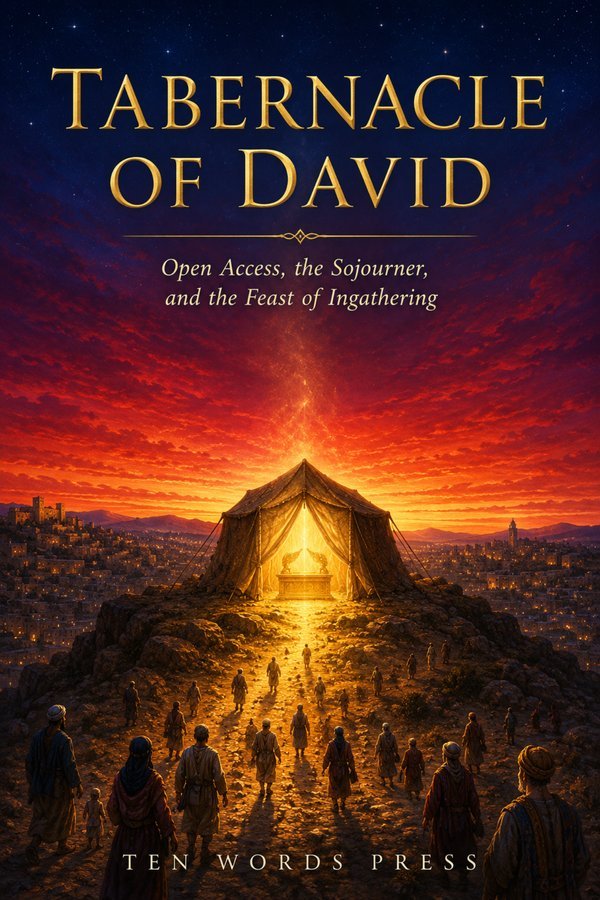
Tabernacle of David
Open Access, the Sojourner, and the Feast of Ingathering
When David brought the Ark of the Covenant up to Jerusalem, he did something no one had done before. He did not carry it back to the tabernacle of Moses at Gibeon, with its courts, its curtains, and its veil. He set it in a simple tent on Mount Zion, and around it he appointed singers and musicians to minister before the Lord continually. For a generation, worship went up day and night before the Ark, with no veil hanging in the way.
Centuries later, Amos promised that God would raise up the fallen booth of David. And when the apostles met in Jerusalem to decide whether believers from the nations had to become proselytes, James settled the question by quoting that very promise.
Tabernacle of David follows that tent from David's day to the end of the story. It opens with the Ark coming home and two tents standing at once, one on Zion and one at Gibeon. It explores the missing veil, the unbroken song, and David in the linen ephod, a king ministering as a priest after the order of Melchizedek, the ancient king of Salem.
The middle of the book turns to Acts 15 and the council at Jerusalem. The nations were not made proselytes. They were welcomed as sojourners, as God had always intended, joining themselves to the Lord and grafted into one olive tree as one new humanity.
The closing chapters connect the booth of David to the Feast of Tabernacles, the feast of ingathering, when all nations will come up to worship the King, and to the day the tabernacle of God is with men.
Four appendices and a glossary complete the volume.
The tent is open. The nations are invited in.
- Author
- Charles Vance
- Category
- Deep Dive